Space activity is very much in the cultural zeitgeist. The media coverage of Artemis II and its crew journeying around the Moon evoked memories of the 1960s Apollo astronauts. Meanwhile, on Earth, the polarising figure of Elon Musk has revolutionised access to low Earth orbit, and his Starlink network provides global internet access while dramatically increasing the orbital population of satellites. The ISS has enabled over 25 years of continuous human presence in space, and as it approaches the end of its operational life questions are being asked of how to bring such a huge object safely down to Earth, and what will replace it.
Sitting alongside the simple wonder of humans exploring outer space, and marvelling at the technological achievements that make it possible, are more prosaic but no less important issues of law and governance in space. The Outer Space Treaty allows signatory nations the right to explore and use space, then places key limitations on those rights, such as preventing claims of state sovereignty, barring States from placing nuclear weapons and weapons of mass destruction in orbit, and making States responsible for their own national space activities.
My own career, as an academic researching and teaching space law, has been spent trying to understand how the rules that govern space exploration evolve and survive. Intensifying geopolitical tension is placing unprecedented strain on the international system. The collaboration that brought the ISS into being has given way to a more robust, transactional approach between states. All the while, the space environment grows more congested with the detritus of almost seven decades of human activity.
“It introduced me to the legends of Apollo: the almost mythical astronauts who would embark on this superhuman endeavour.”
Two books, arriving at very different times in my life, provide the backdrop for my intellectual journey into the governance of human activity as it spreads into outer space. Both concern the American space programme, but each shines a light on very different aspects of those endeavours, and each ultimately shaped how I have come to view the field of space law and the challenges that lie ahead in a world that is ever more fractured and bellicose.
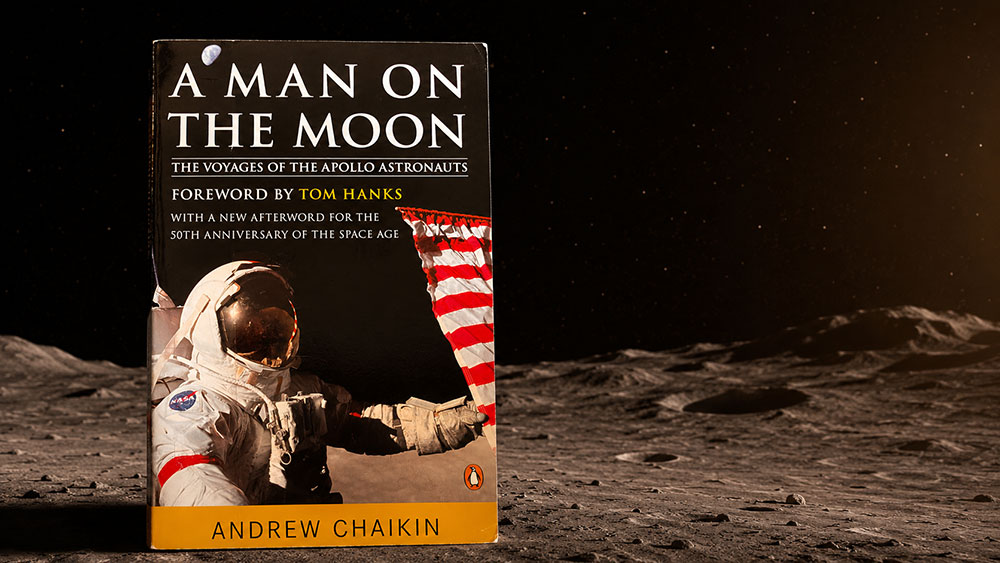
The first book is A Man on the Moon by Andrew Chaikin (Penguin, 1995), a work of epic scale that took over a decade to write. It is a definitive account of Project Apollo and how humans landed on the Moon, detailed down to the evolution of the hardware, the running of the Astronaut Office, and the selection and training of the astronauts themselves. It introduced me to the legends of Apollo: the almost mythical astronauts who would embark on this superhuman endeavour, and the backroom staff who made it all possible.
Chaikin’s book tapped straight into my childhood fascination with space. Up to that point, my love of space exploration had largely been a love of hardware, which is perhaps understandable; a boy growing up in the era of the Space Shuttle could be forgiven for being transfixed by the technology and the sheer audacity of how humans were getting off the ground. A Man on the Moon is a comprehensive and reverential account of arguably the greatest collective achievement in human history. I have read it more times than I can count.
The second book, and the one that was pivotal to my academic journey into space, arrived later. It was Riding Rockets by Mike Mullane (Scribner, 2007), a former Space Shuttle astronaut. Where Chaikin captures history through the lens of a sprawling national odyssey, Mullane gives a very individual and hilariously candid account of post-Apollo NASA. His is the story of one human being navigating entry into NASA’s astronaut corps in the years after Apollo. That personal perspective had a profound effect on me, and on my career.
“Space exploration had always been my hobby, my life outside work. Reading Riding Rockets, I realised that space is not just what I am interested in. It is part of who I am.”
Mullane’s pages are populated by names that, up to then, had held a mythological status similar to the Apollo astronauts: Sally Ride, Hoot Gibson, Judy Resnik, Steve Hawley. These were the legendary figures of my space-obsessed childhood. Mullane made them real, giving them humanity, with ambiguity, moral uncertainty and doubt. He drew them as colleagues, rivals and friends.
By the time I read his book I had been through two careers and was starting my third. I was, in a sense, in exactly the position Mullane describes when he applied to be an astronaut: here, at last, was a chance to do something I actually wanted to do. Space exploration had always been my hobby, my life outside work. Reading Riding Rockets, I realised that space is not just what I am interested in. It is part of who I am.
That same recognition is why John Newton’s hymn on a lunar eclipse resonates so deeply with me. Newton was not a scientist. He was a clergyman in a small market town, and on the 30th of July 1776 he looked up at the Moon and had a profoundly human experience of the cosmos. He was not trying to fathom orbital mechanics or planning a mission. He was standing in the dark, watching a shadow move across something beautiful, and feeling the weight of it.
The unmediated experience of simply looking up is what space law ultimately exists to protect. Not for the engineers, the businesses or the astronauts, but for anyone who has ever stepped outside on a clear night and felt something shift at the sight of the Moon. The desire to go there, set out in painstaking detail by Chaikin, and the billions of dollars and millions of hours it consumed, were all driven by the same awe a person can feel simply by looking up. It is no small irony that the same constellations transforming life on Earth are beginning to crowd the night sky itself, dimming the very view Newton stood beneath.
“It taught me that even in an endeavour as technically extraordinary as spaceflight, the human element can never be forgotten.”
From working in a law school, it is a short journey to the work of the early founders of space law: Andrew Haley, Bin Cheng, and the others who grappled with the extraordinary legal and ethical questions thrown up by humanity’s first steps beyond Earth’s atmosphere. What I did not fully appreciate, until I began that journey, was how completely the writing of Chaikin and Mullane had already prepared me for it. The voyage of the Apollo spacecraft showed the need to understand the unique operating environment of outer space. Riding Rockets enabled what I now think of as the shift from hardware to human. It taught me that even in an endeavour as technically extraordinary as spaceflight, the human element can never be forgotten.
For most of my life I had believed that space belonged to my heroes: the engineers, scientists and astronauts mythologised in Chaikin’s book. Studying space law has taught me the danger of that assumption. Space should not be the exclusive property of heroes, or nation states, or billionaires with rockets. It belongs to us all. Those who journey into space are as bound by law and obligation there as they are on Earth. Space is not lawless, and human activity beyond our atmosphere should not be unfettered. The same questions of governance, accountability and shared responsibility that we wrestle with on Earth are just as pressing as humanity moves into space.