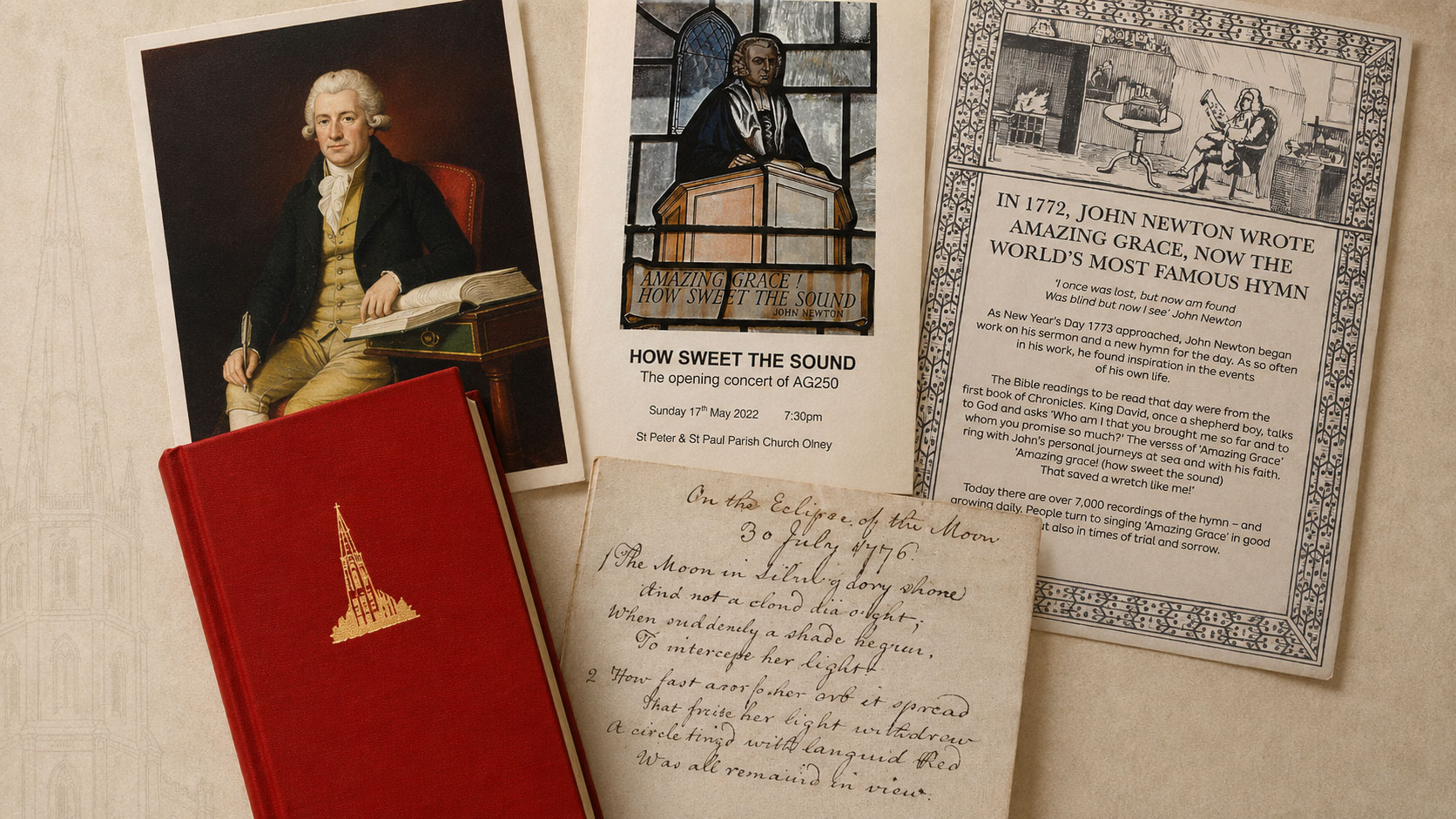
In a letter to John Thornton dated 6th August 1776, John Newton wrote: “I observed the Eclipse of the Moon on Tuesday night”. Given that 6 August of that year was itself a Tuesday we can take it that Newton saw the Eclipse on the previous Tuesday, 30th July. This is fully consistent with Newton’s diary entry for that day, which reads: “Tonight I attended an Eclipse of the Moon.” NASA’s Catalog of Lunar Eclipses 1701-1800 provides a little more detail relating to what precisely Newton saw. There was indeed a total lunar eclipse on the night of 30th July 1776. It peaked at 00.02.02 on 31 July 1776 (NASA, 2011) and was completely visible in the UK. Full details may be viewed here.
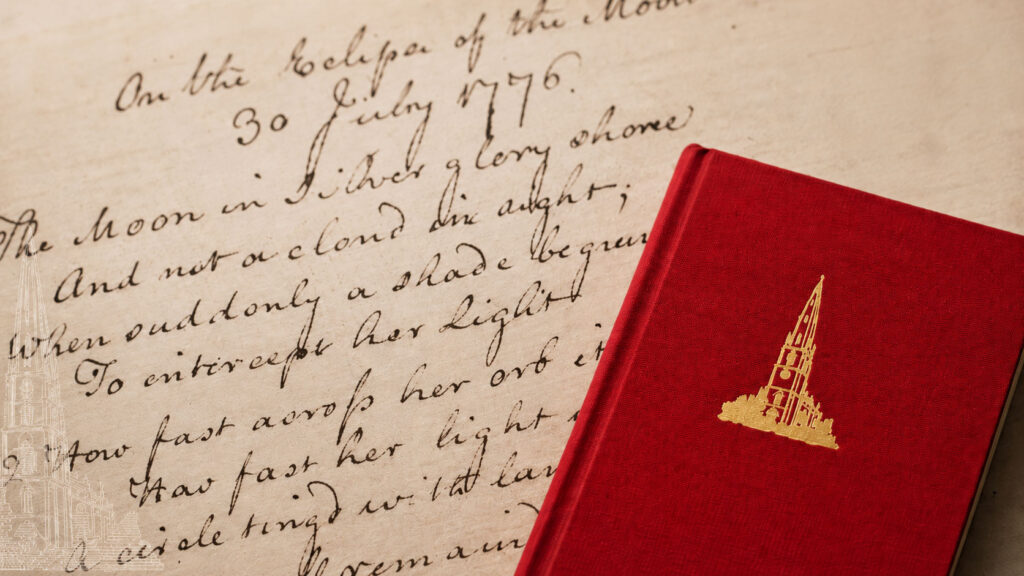
Whether the hymn “On the Eclipse of the Moon” was written on 30th July or a day or two after is not entirely clear. The manuscript (MS) of the hymn reads: “On the Eclipse of the Moon 30th July 1776”, but the date here is most likely that of the moon’s eclipse rather than the date of Newton’s authorship of the hymn that celebrated his viewing of it, though of course it could be both. On 6 August (Tuesday) he wrote in his letter to Thorton that “last night” (Monday) he preached upon the hymn at “The Great House”. It is a reasonable reconstruction that he also preached from his hymn on 5 August (Sunday), though the diary entry for that day does not make explicit mention of it, only that he “spoke on the late eclipse”. In the MS version of what was later published as Olney Hymns (1779), a MS that bears all the marks of it being fair copy for the printed edition, dates of composition are not routinely given. The Eclipse hymn, though, still has the date 30th July 1776. This seems to make the situation clear: the date is that of the eclipse and not necessarily that of the hymn’s composition. Even so, in contrast to the situation with many other hymns of the Evangelical Revival, we have a high degree of precision in seeking to date the composition. It was written either on 30th July or 1-5 August 1776. In the published edition of Olney Hymns it appears by reference to its first line as “The moon in silver glory shone” and is hymn 85 of Book 2 (1779). The original may be viewed here.
As noted, the hymn was evidently one of which Newton made homiletic use. From the summary of his key points addressed to Thornton, Newton gives us an insight into what his meditations were that drove him to compose the hymn. We can pick out three.
First, that the eclipse symbolises the Saviour’s passion. Stanza five comes into view here:
Thy people’s guilt, a heavy load,
(When standing in their room),
Deprived thee of the light of God
And filled thy soul with gloom.
In the biblically-saturated mind of this eighteenth-century evangelical, the symbolism of the eclipse is rich. As the earth’s blocking of the light of the Sun plunges the moon into darkness, so, at the crucifixion, humanity’s sin blocks the light of God and darkness falls upon the crucified Messiah. It is entirely probable that Mark 15.33-34/Matthew 27.45-46 is at work here:
And when the sixth hour was come, there was darkness over the whole land until the ninth hour. And at the ninth hour Jesus cried with a loud voice, saying, Eloi, Eloi, lama sabachthani? which is, being interpreted, My God, my God, why hast thou forsaken me? (Mark 15.33-34 KJV).
Newton is explicit: it is the light of God that is eclipsed by sin and darkness falls upon the figure of the crucified Christ. But once set free the image takes on a life of its own as, in turn, we see the light of the world itself eclipsed as death comes (cf. John 1.8). As is generally the case with this genre of hymnody, further scriptural allusions are possible: “The peoples’ guilt, a heavy load’ may echo Isa 53.6; the gloom in Christ’s soul may be that of Matt 26.38. The parenthetic “when standing in their room” expresses perhaps the most central of all eighteenth-century evangelical doctrines: the substitutional death of Christ.
Second, from his observation of the eclipse, instruction comes to Newton on the matter of the regularity of the heaven’s movements. This is no abstract exercise in natural theology, though. Rather, the precision evident in the movement of the planets is taken as a clear lesson in the faithfulness of God, who will deliver on his promises. This is clearly a non-sequitur, so hardly likely to appeal to a rationalist. But this is a hymn. And rationalists are not the intended singers of it. Rather, the eclipse of the moon is a springboard to higher thoughts, though there is no connecting staircase between them. Again there are clear echoes of the preachers of the Evangelical Revival. Enlightenment rationalism is replaced by experiential faith. If there is a logic, it is akin to that of Wesley:
‘Tis mystery all! Th’Immortal dies!
Who can explore His strange design?
In vain the firstborn seraph tries
To sound the depths of love divine!
‘Tis mercy all! let earth adore,
Let angel minds inquire no more
Third, Newton recalls the promise of the book of Revelation, although actually one can almost see him mentally stall slightly before he recalls it in his account to Thornton. At first he draws the lesson that one day the world will pass and light will replace darkness and the Sun will no more go down, neither the moon withdraw its shining. But then he recalls the precise promise of scripture: “And the city had no need of the sun, neither of the moon, to shine in it: for the glory of God did lighten it, and the Lamb is the light thereof” (Rev 21.23). In writing to Thornton it is with reference to such apocalyptic hopes that he outlines what was in the content of his Monday night sermon. In the hymn itself, however, the thought is on a much more individual level.
Dark, like the moon without the sun,
I mourn thine absence, Lord!
For light or comfort have I none
But what thy beams afford.
For the one acquainted with Wesley’s work, a parallel will quickly jump to mind. It is found in one of his most beautiful compositions: ‘Christ, whose glory fills the skies’ (1740), the second stanza of which reads:
Dark and cheerless is the morn
unaccompanied by Thee;
joyless is the day’s return,
till Thy mercy’s beams I see,
till they inward light impart,
glad my eyes, and warm my heart.
These lines predate Newton’s hymn by some 36 years. But while the Wesleys and Newton crossed paths many times and were brothers within the wider Evangelical Revival, one does not suspect a direct dependence of the latter upon the former. Rather, both are drawing on a common spirituality within which complete dependence upon, and submission to, Christ, was central and the spiritual is raised above the physical. The physical dawn leaves Wesley cheerless, and Newton, upon seeing the eclipse, can only reflect on how he is dark too, like the moon robbed of the Sun’s light by the Earth’s shadow. Light, warmth, comfort and gladness have but one true source: the mercy beams of Christ, the Sun of Righteousness.
The literary quality of this hymn is clearly evident. The meter is simple, but, as Newey notes, it shows Newton’s ability to write in a tightly-disciplined style. I rather disagree with Newey, though, in that he appears to suggest that this hymn is rather more measured in its religiously-driven enthusiasm. Content and form are perhaps more easily separated to leave us with a measured style on the one hand, and a soaring theological outpouring on the other.
Kenneth Newport is Emeritus Professor, Liverpool Hope University, and was formerly Deputy Vice-Chancellor. An Anglican priest, he has both D Phil and Doctor of Divinity degrees from Oxford, and is also now a student of astro-physics. An indication of his commitment to Charles Wesley research can be seen here: https://www.hope.ac.uk/news/allnews/academics-new-book—25-years-in-the-making.html
and his other books include
Apocalypse and Millennium: Studies in Biblical Eisegesis, Cambridge University Press, 2000, and The Branch Davidians of Waco: The History and Beliefs of an Apocalyptic Sect, Oxford University Press, 2006.
References
NASA (2011) “Five Millennium Catalog of Lunar Eclipses” [Online] Available at https://eclipse.gsfc.nasa.gov/LEcat5/LE1701-1800.html
Newey (2019) “The Olney Hymns” The Cowper and Newton Journal vol. 9 Available at https://cowperandnewtonmuseum.org.uk/journal/the-olney-hymns/