By Harbinger
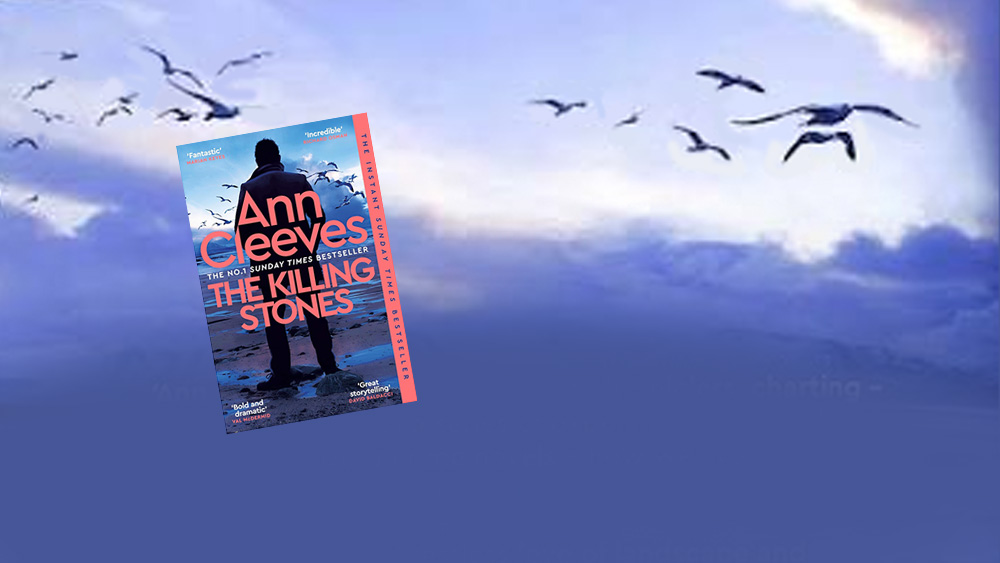
Orkney is a place where history surrounds you, it is a place that looks forward and innovates, but also one where it is hard to avoid the history and the archaeology; from the land around my own house here in Orkney there are number of sites that I can see or walk to. There are stories told of people discovering sites by almost falling over them in their everyday life, and others of people then choosing to lose them again. This new offering from Ann Cleeve is set near to mid-winter, a time when Orkney sees little daylight and lives with a cloak wrapped around it, often having days when the ferry services are unable to run, when the seas appear deep, dark, and threatening; this is part of the backdrop of The Killing Stones, (published by Pan Macmillan).
The focal point is however Westray, one of the more northerly islands in the Orkney archipelago, home to around 550 people, with a number of archaeological sites of settlement that dates back to 3,500 years BCE, whilst also being home to remains from the Bronze Age and the Viking-Norse period. It is in this historically vivid place that the story unfolds, but also within mainland Orkney itself, home to The Orkney World Heritage Site, inscribed by UNESCO in 1999, as the “Heart of Neolithic Orkney,” comprising Maeshowe, Skara Brae, the Stones of Stenness, and the Ring of Brodgar.
To step onto the island of Westray is to step into a landscape where the boundary between the living and the deep past is worn thin by the North Sea gale. In The Killing Stones, Ann Cleeves achieves something far more profound than a conventional regional historical crime novel. She has authored a novel that functions like an archaeological excavation, mapping the complex, buried fault lines of an isolated Orcadian community. By uprooting Detective Jimmy Perez from the bleak, vertical crags of Shetland and depositing him in the fertile, low-lying pastures of Orkney, Cleeves deliberately trades a geography of sheer exposure for one of horizontal historical accumulation.
The narrative dynamic changes immediately. The central tragedy does not emerge from a nameless shadow, but from the soil itself. The body of Archie Stout—a larger-than-life Westray farmer and a childhood companion of Perez—is discovered discarded at an active archaeological dig site near the historic settlement of Pierowall. He has been brutally bludgeoned to death. The weapon is an ancient Westray “story stone,” stolen from the local heritage museum, its face deeply incised with precise, cryptic Neolithic spirals and runes left by later Viking interlopers.
THE STRATIGRAPHY OF WESTRAY
│ MODERN LEVEL: The murder of Archie Stout │
│ 16th CENTURY: Noltland Castle (Feudal over-lordship) │
│ 9th–12th CENTURY: Norse-Viking settlements │
│ 3500 BC: Neolithic Grobust & “Story Stones” │
For the most invested reader, Cleeves’ choice of weapon is an intentional thematic anchor. The spirals carved into the stone mirror the structural design of the novel. The inquiry loops inward, pulling Perez back toward his own youth, forcing him to interrogate a community where every contemporary face masks centuries of inherited insularity. By trapping Perez and Chief Inspector Willow Reeves on Westray due to a violent winter storm, Cleeves recreates the classic “closed-circle” mystery. Yet she populates it not with the stock characters of a drawing-room thriller, but with the heavy, unyielding weight of Orcadian inheritance.
The geography of Westray is handled with an academic rigor that commands respect. Cleeves walks her characters through the shadow of Noltland Castle—an unfinished, sixteenth-century monument to feudal over-lordship—and across the sands near Grobust. Here, the landscape is heavily shaped by its ancient past. Westray boasts a rich density of Bronze Age, Iron Age, and Norse-Viking settlements. By placing the modern violence of Archie’s death squarely upon a Neolithic excavation site, Cleeves reminds us that human nature changes far less than the topsoil. The ancient inscription on the murder weapon is not merely a sensational plot device; it functions as a historical mirror to the unresolved grievances, hidden affairs, and deep-seated grudges of the island’s modern inhabitants.
Where The Killing Stones elevates itself above Cleeves’ previous work, for me, is in its linguistic and psychological insight. The lilt of the Orcadian tongue—so distinct from the sharper, Nordic inflections of Shetland—is rendered with a musical cadence that softens the book’s darker edges. The domestic evolution of Perez, navigating his relationship with Willow alongside the grief of losing an old friend, provides a fragile counterpoint to the rawness of the landscape. The inter-play of relationships throughout the book exhibit closeness, depth, but also the nature of secret kept close within a community where people know each other or believe that they do.
The Killing Stones is a superb achievement. Cleeves treats the detective novel not as a disposable puzzle, but as a cultural document, demonstrating that the deepest secrets are rarely buried entirely out of reach.