By Rebecca Lewis-Oakes
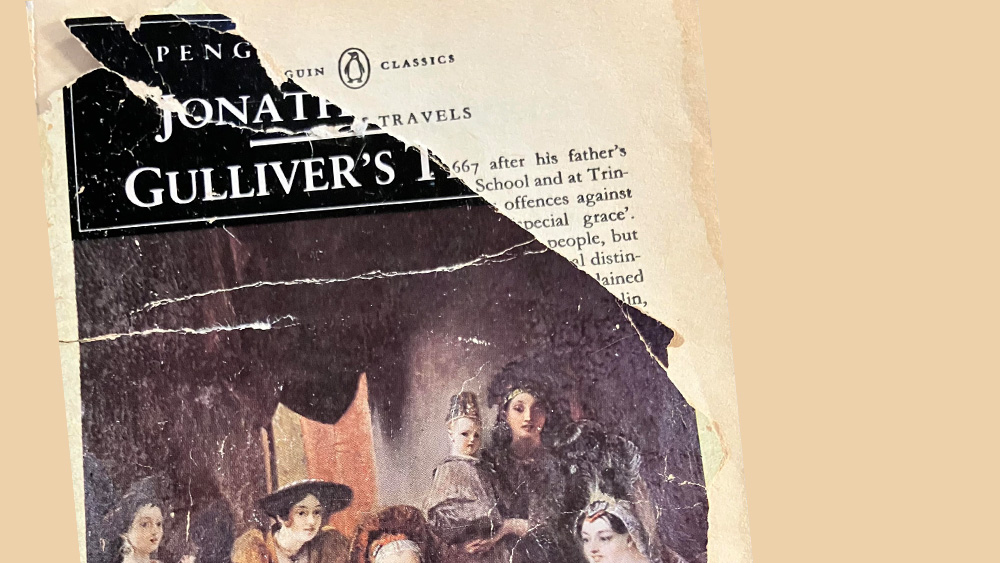
Happy 300th birthday to Gulliver’s Travels. The satirical, inimical travelogue was an instant bestseller in 1726 and continues to inspire all kinds of new editions, illustrations, sequels and retellings.
Written by Jonathan Swift, he kept no notes. No evidence that it was his work. That’s how dangerous he was as a writer. An Irish writer, let us not forget, with caustic (accurate) opinions on how his island was treated by the British across the sea.
So he sent Lemuel Gulliver across fictional oceans to wild lands where humans had never been seen before, to draw stark contrasts and highlight Swift’s own current political climate. The audacity of a writer to suggest that perhaps humans could treat each other more decently than they were currently doing, was too much for most politicians at the time.
Swift’s printer, Benjamin Motte, used five different presses to avoid suspicion as to the real author, as well as to keep up with demand. Its meaning was incendiary at the time. Today, it is often presented as a children’s book. Do contemporary seven-year-olds get all the eighteenth-century satire? Do they need to, to find it funny, or even interesting? Did Swift’s original audience ‘get’ all the jokes, or did they just find its outlandishness silly and amusing? Does it matter? Why do we keep reading these old, old books when over 200,000 new books are published yearly in UK alone?
A 3,000-year-old poem is currently being revived by Christopher Nolan’s Odyssey film (he leaves out all the jokes from the original). Do we not have any new stories to tell and consume?
Well, even when so many stories are circulated, only a few are ever truly standout. And Gulliver is both absolutely erudite in its eschatology of the immortals on Luggnagg, and utterly scatological in the hero’s obsession with bodily output (and the fabulous joke of how Gulliver puts out the fire in Lilliput). There’s something for everyone, for every age. Indeed, the opening premise of Gulliver becoming very, very big to the little Lilliputians, and then very, very small in contrast to the giants of Brobdingnag, is classic Early Years Foundation Scheme ‘opposites’ curriculum. Pre-school children love exaggeration. You don’t need to have a degree in literary appreciation to get the joke here.
A clever book like this lends itself to endless adaptation. Is that why it’s lasted in the popular imagination?
Stories that are malleable to their mediums survive. Indeed, Swift was adding another layer of satire by skewering the relatively new genre of travelogue. Remember, the ‘first novel’, Robinson Crusoe, had only just been published a few years earlier. And sea travel was exceedingly dangerous and exotic to most people in 1726.
Today, Gulliver would surely be sent on TravelTok. Perhaps to the Moon, or Mars. Even a TV travelogue genre would be outdated for him now.
To stand out, you have to be the first or the best. Gulliver manages both. The Odyssey was compiled over centuries in the oral tradition of epic poem performances and (generally agreed) written down, consolidated in the form we have it today, in around the fifth-century BCE. But new translations abound and help us to rediscover the original for each modern audience.
Gulliver is reinvented all the time and unlike many ‘classics’, is mostly suitable for all ages. In children’s publishing we are very concerned with ‘content’ vs age range. Perhaps Christopher Nolan was worried about his audience’s age and that’s why he took out all the (central, many would argue crucial) sex from Odysseus’s travels in his film. Gulliver is remarkably ‘content’-light in the original, making it much more appropriate with little censorship. There is no hanky-panky on the page, characters abhor violence, and the rude jokes are frankly the exact kind that delight little readers.
I am currently on my own reading odyssey, working through the list of ‘classics’ that Matilda Wormwood’s kind librarian recommends to the precocious four-year-old, after she has finished ‘all the books in the Children’s section’.
Most of these, I regret to advise Mr Dahl, are wildly inappropriate for today’s child reader. Mostly, the language is completely impenetrable even for this 41-year-old. Except for maybe Animal Farm, but that opens with the farmer being drunk which might be classed as inappropriate content today.
These classics have lots of great scenes and characters which do appeal to all ages, and stand the test of time. So, how and when do publishers decide to produce children’s version, edit, abridgement or illustrated reimagining of a classic? In my experience, it often hangs on an anniversary or something else in the zeitgeist, or an illustrator producing a piece based on their own memories of a moment in a story. There are obvious reasons why to omit certain passages, and often the text offers it own clarity on which bits to highlight. As former Children’s Laureate, Frank Cottrell Boyce advises writers, always ‘put in a “good bit”’ that you enjoy writing, it’s clear on a re-read which outdated (read: racist, sexist, sizeist, all the -ists) elements of a classic need glossing over or up.
Great artists are great editors: choosing exactly which moments to include in a snapshot still of a longer text story. Illustrations of those standout moments like Gulliver towering over the Lilliputians, or cowering from the Laputan floating island’s attacks, create more easily shareable lasting memories, perhaps, than our reading of the text. All of this is only worth it if the central message of a story is worth distilling and passing on. Swift created so many iconic scenes within his classic, that it is unsurprising it’s lasted three centuries.
I can confirm that reading Gulliver’s Travels in the original tested me, too, but was it worth reading it as Swift wrote it? Absolutely. Good satire sheds self-reflective light throughout the ages. Something we all need occasionally, if not constantly.
Popular culture still recalls the Lilliput vs Blefuscu controversy over which end of the egg one breaks first – the Big End or the Little End – which ultimately meaningless decision causes disagreements and wars over something so trivial. Swift was referencing Anglo-French rivalries and British Christian divisions, of course. But I confess I read this while the England Argentina World Cup match was on and I had the strong feeling of déjà vu when Gulliver marvels at the Lilliputians’ ridiculously petty rules for sports (a sort of high jump/limbo combo) and whether any of it matters more than just treating other peoples with decency.
Recommended For You
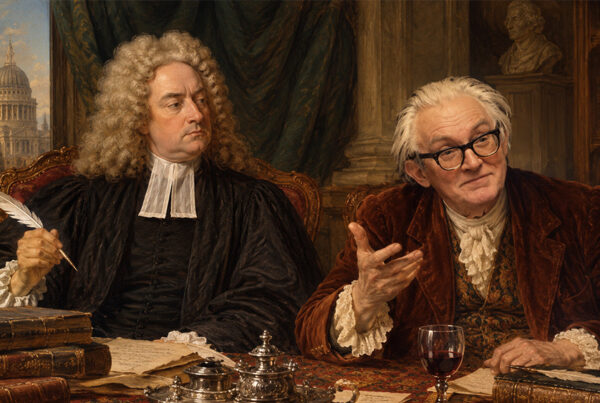
 The Storytellers: From Herodotus to Dean Swift and beyond.

David ButlerOctober 22, 2026
 On going across the water to university

Simon Lee, EditorOctober 22, 2026