
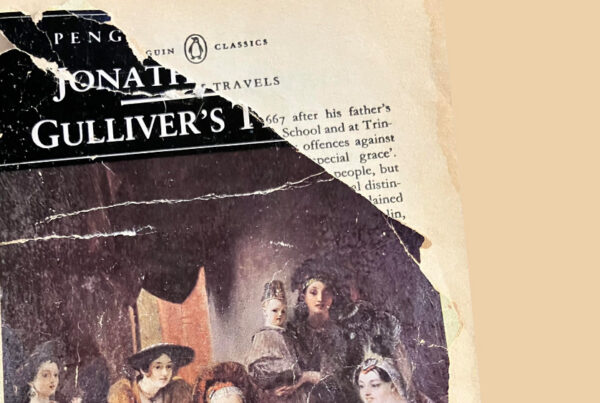
We are often told that politics on either side of the Atlantic is beyond satire. The same is increasingly said of life in universities, in faith communities, in the media, in sport and in other walks of life. Satire can still work, however, to illuminate the human condition and to entertain us. So I would recommend marking the 300th anniversary of Jonathan Swift’s Gulliver’s Travels this October by reading not only this famous satire itself but the preface written by Michael Foot for the Penguin Classics edition in 1967.
Michael Foot was at the time a backbench MP. He had many talents as a media editor with accomplished academic credentials and a radical outlook, championing a range of positions from atheism to unilateral nuclear disarmament. He later became a Cabinet Minister and eventually the leader of the Labour Party. In that last role, he was the prime mover in the Labour manifesto of 1983, which went beyond satire in proposing immediate departure from the European Community, without a referendum, and unilateral disarmament. It was memorably described by a fellow Labour front-bencher, Gerald Kaufman, as ‘the longest suicide-note in history’. Labour lost heavily to Margaret Thatcher’s Conservative Party.
Two years after writing his preface to Gulliver’s Travels, the radical left-winger Michael Foot formed an unholy alliance with the right-wing Enoch Powell to thwart his own government’s attempt to reform the House of Lords. This also seemed beyond satire. Powell wanted to keep the status quo. Foot wanted to abolish the Lords. They combined forces to defeat a proposal to remove hereditary peers which might have given the Lords more legitimacy when it came to challenging the Commons but which would have given the Prime Minister yet more patronage.
Decade after decade, Michael Foot was a great orator and writer. At the age of 90, he was honoured by the football club he had supported all his life, Plymouth Argyle, who signed him up as a player and gave him the number 90 shirt.
When he was writing his Preface to Gulliver’s Travels in the 1960s, political satire had become a television genre, most notably through That Was The Week That Was. David Lodge was writing a satire on universities and on Catholicism, The British Museum is Falling Down. Lodge even parodied the style of famous authors in different chapters although this was missed by most reviewers.
It says something about the quality of minds and the hinterland of politicians in the 1960s that one could be chosen by Penguin for this task and several others might have been. Michael Foot, a consummate reviewer, had a command of the book in question and the history of its popular and critical reception.
‘When the book was published, anonymously, on 28 October 1726, success was instantaneous. One report said that ten thousand copies were sold in three weeks. Immediate translations were made into French and Dutch, weekly journals started printing pirated extracts …’
Yet Swift was deluged with criticism for the bleak view of human nature which some, led by Dr Johnson, discerned in the satire. Swift had anticipated this and had forewarned his publisher. The book has sailed on to remote nations of the world and to every kind of success over three centuries. Foot reported that, from the beginning, as
‘Alexander Pope and John Gay wrote jointly, “‘From the highest to the lowest, it is universally read, from the cabinet council to the nursery”.’
For the rest of the eighteenth century, however, there was intense criticism of Swift. Towards the end of that century and in the nineteenth century, Foot’s heroes, such as Godwin, Cobden and Hazlitt, rescued Swift’s reputation but they were all radicals which led some of Swift’s fellow Tories to wonder what to think. Foot traces all this and is critical in the twentieth century of George Orwell being critical of Swift in the eighteenth.
Michael Foot finds joy in what he describes as the second best indoor sport, inferior only to chess, of trying to work out who or what were Swift’s targets because
‘The book is stuffed with personal, literary and political allusions. On every page there are more or less abstruse references which had a special meaning for the readers of Swift’s own age.’
Re-reading Foot on Swift has led me to think that nothing is beyond satire. So I have written a micro-novella which has just been published. Snow in a Cambridge Heatwave takes to new heights the tendency of leaders in universities and wider society to run away when their presence is most needed. In a toxic environment, in the heat of a controversy, when their solidarity could mean the world to a beleaguered colleague, this satire imagines ten leading figures each taking flight. They are all up in the air. Cambridge’s heads are in the clouds.
But instead of simply lampooning these characters, the story celebrates ten research students who each follow one leader. Accused of being the snowflake generation, they actually sprinkle snow on, bringing grace to, proceedings. On catching up with each leader, on a plane or at an airport, a student-tracker urges them to return to ground level back in Cambridge. Who, if anyone, will turn back to make a difference?
F M Cornford’s 1908 Cambridge satire Microcosmographia Academica exposed the ploys used in the university to resist change but did not offer guidance on counter-moves if you positively want change.
Film Studies is sometimes dismissed as a ‘Mickey Mouse’ subject and the Humanities are said to be in decline, but these student-trackers use their knowledge of films to point their leaders in the right direction.
The underlying controversy is not explained, no sides are taken, it could be any one of a number of crises for Cambridge over the decades, and it is only referred to as the Affair, alluding to the title of a novel about a fictional controversy by the Cambridge scientist C P Snow, The Affair. The chasing all happens in 24 hours and we do not learn what happens thereafter in the controversy itself.
In an epilogue set almost a year later, however, the characters all come together at a Cambridge May Ball with a Titanic theme. For those who enjoy Michael Foot’s Preface to Gulliver’s Travels, will a Labour Party leader be rearranging the deckchairs?
Simon Lee is the founder and editor of the Olney Review of Books.
Snow in a Cambridge Heatwave is available in paperback, for Kindle and as an audiobook. https://www.amazon.co.uk/Snow-Cambridge-Heatwave-Microcosmographia-Academica/dp/B0HLMF97TR





This summary cleverly links classic satire and historic political drama to a new novella. It highlights how the author subverts the “snowflake” stereotype by making students the sensible heroes during a crisis. Overall, it is a smart and engaging pitch for a modern satirical story