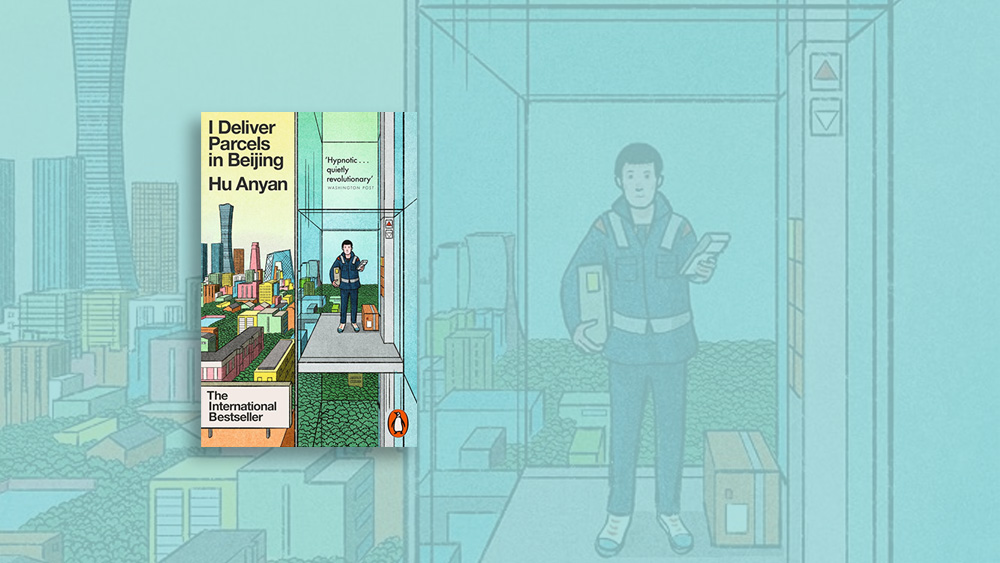
By Zi Yang
I was given one task: to review Hu Anyan, I Deliver Parcels in Beijing: On Making a Living (Penguin 2026) for the Olney Review of Books (ORB). As someone who has written about the gig economy, grew up in China, and shops online, I felt qualified for the job, which was a rare experience.
The book is an enjoyable read. Hu Anyan’s writing is remarkably accessible, with observations and reflections presented in plain language (originally in Chinese, while the style was kept in the English translation by Jack Hargreaves). Some critics regard the book as too plain and lackings dramatic tension. In a sense, they are right. There is honestly very little spectacular suffering and dramatic conflicts in this book. The greatest financial losses suffered during Anyan’s courier period involve repairing the old tricycle, compensating customers for missing parcels, and forfeiting a rental deposit after moving out early. This differs from stereotypical narratives of life at ‘the bottom’. In fact, many workers appear surprisingly unfazed by redundancy. Some, including Hu Anyan himself, intentionally refuse re-employment opportunities because couriers can generally find work elsewhere easily.
The book’s value lies in the honest account of gig work. News reports tend to focus on scandalous explosive exploitations, whereas academic research often identifies broad patterns and structural trends. Never Neither of them precisely conveys what the experience is of the day-to-day gig work. And as Anyan demonstrated, that experience is boring. Literally, ‘boring’. There is little worth remembering after endless physical labour. Workers move, unpack, and repack parcels until their fingernails begin to fall off. They travel repeatedly between headquarters and local depots while navigating lengthy and bureaucratic onboarding processes. They cycle through twenty or more jobs over a number of years, eventually reaching a point where they can no longer remember the names of former employers. Plus, there is simply little time left to live after more than prolonged hours, except alcohol, karaoke (for some) and books (for Hu Anyan).
Within this environment there is also a noticeable absence of humanity, the lack of willingness to help the weak. The logic is again brutally simple: workers help the strong because the weak slow everyone else down. Similar attitudes shape relations among delivery drivers themselves. Nobody wants to be paired with the slow worker, the newcomer, or the colleague without a tricycle. The arrangement makes perfect economic sense, even if it leaves little room for solidarity.
Perhaps, the darkest confession Anyan made was to maintain a list of customers who he resented and imagined taking revenge upon. That unsettled me because I could well be on that list. I definitely had parcels delivered to my old address and asked if someone can could help returning it; I might have asked if they could come back later on in the day to deliver my groceriesy; my old apartment was notoriously like a maze, even I struggled to find my room; and I certainly argued with my Uber Eat deliverer to say, no, that picture was neither my building nor my order. I suspect you may have similar experiences. Most conflicts got resolved as Anyan went back and delivered the parcels. And like Anyan’s customers, I am also grateful for the services I have received.
These incidentsces reveal a deeper economic imbalance.: Customers paid for services. Yet, only a tiny fraction of that payment eventually reaches the gig workers who deliver them. As Anyan explained, customers may have paid twenty-three yuan for S Company’s service, which was more than double the average market price in China. But couriers receive around 1.6 yuan across companies anyway and are expected to absorb loses and damages. Thisese unfair distribution of profit and obligation is largely invisible to customers, which leads to expectation gaps that underliey the conflicts.
Indeed, economics is at the centre of the book and gig work. I was struck by Hu Anyan’s habit of calculating the value of his time down to the minute. Every detour, every signature collected, and every additional trip represents money gained or lost. Interestingly, there are substantial differences between companies. One firm prioritises customer satisfaction and insists on signed deliveries. Another emphasises efficiency and teaches drivers strategies to avoid return trips. Another focuses on servicing customers from its own platform and devotes greater attention to returns processing. Yet, they pay couriers at very much the same rates.
As someone who studies gig work and precarious labour, very little in Hu Anyan’s account came as a surprise. The bureaucratic absurdities, the constant calculation of time, the weak solidarity among workers, the endless churn between jobs, and the quiet acceptance of insecurity all resonated with patterns familiar from both research and experience. Hu Anyan’s account gives humanity to these abstract legal debates.
It is also worth questioning the common tendency to praise the book primarily for its ‘grassroots’. While Hu Anyan is certainly not an academic writer, describing him simply as a worker from the bottom of society gives an incomplete picture of himself and the gig economy. For Hu Anyan, he was born in Guangzhou, one of China’s largest cities, and was raised by parents employed in state-owned enterprises. This background is certainly not underprivileged in the Chinese sense, which mainly refers to domestic migrant workers coming from farming backgrounds. Hu Anyan unpacked his family history in another book, Live in Low Places, , andwhich may would resonate with many Chinese readers going through their own ups and downs.
This matters because the social composition of gig work is changing. The image of platform labour as coming preliminary from disadvantaged farming and marginalised similar disadvantaged groups has become increasingly difficult to sustain. Economic slowdown and corporate restructuring have pushed many former white-collar workers towards blue-collar gigs. In China, it is quite common to hear former office workers becoming Didi (the Chinese version of Uber) drivers after redundancy. Reading Hu Anyan’s account solely as a story of the ‘grassroots’ risks missing this larger point. The labour market precarity is expanding and the distance between the middle class and working class is shrinking. This is not an ‘another people’s problem’.
Then, as someone who lives in the UK, it is also difficult to describe this as a ‘Chinese’ story or an account of ‘China’s change’ alone. I suspect the opposite. While the book is undoubtedly rooted in China, the experiences travel well across borders. In Hillbilly Elegy, J. D. Vance, now the Vice-President of the USA, writes about a form of hardship that is not exactly unemployment. Rather, it is tedious intense physical labour, fragile social networks, and communities struggling with the sense of dignity and self-worth. Similarly, James Bloodworth’s Hired: Six Months Undercover in Low-Wage Britain documents the realities of life inside a UK Amazon warehouse. There, the working environment felt so dehumanising that immigrant workers were shocked to see British people working there. While the contexts are different, the themes are familiar: physical exhaustion, high labour turnover, and the sense that people are disposable.
Therefore, Hu Anyan’s account feels less like an exposé of a hidden Chinese reality, but a vivid case study of a wider transformation of work and society. The parcel centre in GuangzhouChina, the Amazon warehouse in Britain, and the floor tile distribution company in the USA are not identical settings. They reveal common patterns of precarity and hardship. That resonates with readers in China, the UK and the USA.