By Macy Grace Butler
The London Missionary Society was an interdenominational, evangelical organisation founded in 1795 with the principal purpose of preaching to and converting non – Europeans to Christianity (Council for World Mission, 2022). Missionary activity began in the South Pacific where they achieved significant conversion by the mid 19th century, ‘spearheading the introduction of Protestant Christianity’ to the islands (Council for World Mission, 2022). Of today, the South Pacific islands remain predominately, 90%, Christian, by the work of London Missionaries (Christianity Today, 2024).
Central to their plan and constitution was the objective, ‘to spread the knowledge of Christ among the heathen and other unenlightened nations.’ (SOAS University of London Archives, 2000) Here ‘heathen’ and ‘unenlightened’ are synonymous to being described as pagan, which refers to those who do not belong to a widely recognised religion (Pagan, no date).
Certainly, the London Missionary Society was motivated by the genuine belief and perceived moral duty to share the ‘glorious gospel of the blessed God’ (Orchard Road Presbyterian Church, admin 2011). Their membership consisting of ministers, laymen, Church leaders and pre – ordained missionaries (SOAS University of London Archives 2000) testify this. As well as, when the missionaries came to the South Pacific, establishing churches was the clear priority of their agenda. However, alongside evangelism, there was indeed an undercurrent of civilising influence in their operations, as seen in Tahiti, where they established a law code drawing upon the British constitution, currency and European models for fashion, housing and production (Foster, S. 2019). Resultantly, the Pacific Islanders learned from both the rudiments of religion and the rudiments of the Western world.
Here, the issue lies in whether this was ethical. Most convincingly, the missionaries saw themselves to be well intentioned do-gooders from both their sincere religious conviction and a sense of moral obligation to save souls. For the missionaries, converting others was the highest form of compassion, representing turning from sin towards a new life in Christ. So central to Christianity, that believers are named the ‘fishers of men’ (Bible Gateway, no date, Matthew 4:19), having been granted the responsibility to bring others into the faith.However, what does this make of the indigenous, were not respected to live and let live, but were encouraged to abandon their own culture, tradition and way of life because conversion appealed to someone else’s belief system. Regardless of good intent, London Missionaries were part of thecolonial world, where weakening local cultures worked to the interventionist’s benefit. For this reason, the ethical validity of colonial missionary work should be questioned.
Central to doing so is in understanding of what is ethical.This centres on whether ethics are timeless or do they evolve and one’s beliefs in what is ethical is a product of their society. Therefore, the historical framework which the London Missionaries operated in, being of Empire and racial hierarchy (Council for World Mission 2022), must be appreciated. However, it will not be served. Instead, the South Pacific missions will be presented in a broader modern context of fairness and respect, where the gift of hindsight is valuable in assessing the ethical validity of LMS operations.
The similarities drawn between London mission and British colonialism is in their shared appeal to bring civilisation to far societies on the premise that British ways of life are objectively attractive and superior to their indigenous counterparts. In fact, in the second era of British Imperialism, missionaries often acted in conjunction with colonial authorities, suggesting that seeing a likeness is not too radical (Mitchell, P. 2014). In this way, London missionaries have been named ‘surrogate imperialists’ (Johnston, A. 2021), in how they embedded British civilisation, education, healthcare, language and Christianity into South Pacific communities, yet still framing it as a humanitarian project.
Despite London Missionaries acting under their own impetus, to bring Christ to non – believers, they undoubtedly deviated from this spiritual mission, becoming ‘military strategists, economic advisers, political sages, and legal and constitutional draughtsmen’ (Howe, 1984, p.144). However, seemingly, this was a help in hand, uplifting other countries to share at least a semblance of Britain’s superiority. This would be later named ‘the White Man’s Burden’, by influence of Rudyard’s Kipling’s 1899 poem, framing intervention as selfless and necessary when it is to uplift a race where man is ‘half devil and half child’ (Kipling, R. 1899). Therefore, the London missionary intervening with the ‘savage’ was justified in their historic framework. In turn, they would oversee the prohibition of traditions, destruction of both local temples and artifacts and the introduction of British styled garments (such as bonnets for the women to both align with Victorian modesty standards and to create a picture of civilisation (Johnston, A. 2000)).
The civilising mission was a 19th century colonial ideology which sought to justify the imposition of Western culture, education, technology and Christianity. The rationale at its core was about ‘morally and materially uplifting, improving and later developing the supposedly backward’ (Watt, C.A. 2011). Certainly, British colonial rule did not flinch from the assertion of this. Under British influence in the 18th and 19th centuries, her colonies adopted her fashion, education system, military techniques, housing and most relevantly, religious belief (Fanon, F. 2008 [1952]).
The conviction was, that the West could finally ‘spark’ these countries ‘into motion’ (Baring, 1910)since being previously static or irrelevant. What was regarded as ‘motion’, was motion towards European ways of life which were commonly perceived as the template for effective civilisation. Naturally, this successfully expanded British influence. With the 18th century seeing rising tensions between European powers ‘vying for monopoly’ (Brain, J. 2019) in new regions, mission could potentially be another means in which Britain could expand their influence. Provided that with missionary intervention, the mission bases in the South Pacific also became outposts of British culture, reinforcing colonial structures.
While missionaries and colonialists are fundamentally different, particularly in their core motivations, being of resource or economic exploitation and religious endeavour, respectively, they carried the same civilising ethos. Where both aimed towards the erasure of indigenous culture and subsequent adoption of British civilisation. Furthermore, the issue is in impact and what they reinforced, that the European is paramount and the indigenous, inadequate.
Degrading indigenous social structures is a clear breach of modern ethical standards considering the modern emphasis on cultural relativism, where tolerance for other cultures is promoted, rather than a belief in racial hierarchies. On the other hand, since missionaries were acting in alignment with the ethical standards which reflected the worldview of the time, this is not a fair assessment. In the colonial world, the belief that British ways of life were objectively attractive was genuine and therefore missionary (or colonial) agents had a perceived responsibility to uplift others to this standard. Additionally, provided they were motivated by religious belief, the judgement that they saw themselves to be well intentioned, and ethical, is strengthened. “While missionaries and colonialists are fundamentally different, particularly in their core motivations, being of resource or economic exploitation and religious endeavour, respectively, they carried the same civilising ethos.”
How this was received in the South Pacific helps dictate whether the spiritual mission was ethical. Stemming from historical missionary activities, several Asian and African countries have implemented anti – conversion laws (USCIRF, 2024) Used to prohibit coercive and forceful conversions, particularly in tribal areas, and to protect against missionary activities (Open Doors, 2022). This suggests, in their histories, conversion has been framed as harassment of religious minorities. However, in the South Pacific, London missionaries are both celebrated and respected, maintaining an active partnership with the independent churches they established (CCCS, 2025), suggesting religious conversion was acceptable. This can be seen in Tahiti, the first island to be converted, and by majority, wilfully (Sissons, 2014). Some for power, others for resources and others again in resonating with the message of Christ.
If the London Missionaries withdrew after spiritual conversion, a judgement on whether their operations were ethical may have been easily reached, however their efforts went beyond this. Missionary involvement began in politics, the economy, society and legal systems signifying an overreach from their primary spiritual mission (Howe, 1984). The peak of which, was on the island of Tahiti, where visitors wrote accounts of their time spent there when under missionary influence. One wrote of the missionaries in the summer of 1839, ‘ferocious oppressors’ and ‘shameless monopolisers’ (Marshall, 1862) Another, Otto von Kotzebue, a Russian explorer who visited in 1824 and similarly criticised missionary intervention for being oppressive in their overreach into economic and military power, replacing the ‘light heartedness of the people’ with a ‘gloomy’ social setting (Kotzebue, 1830, p.168) This suggests that the ethical concern lies more with the further involvement in each mission base than the original spiritual mission.
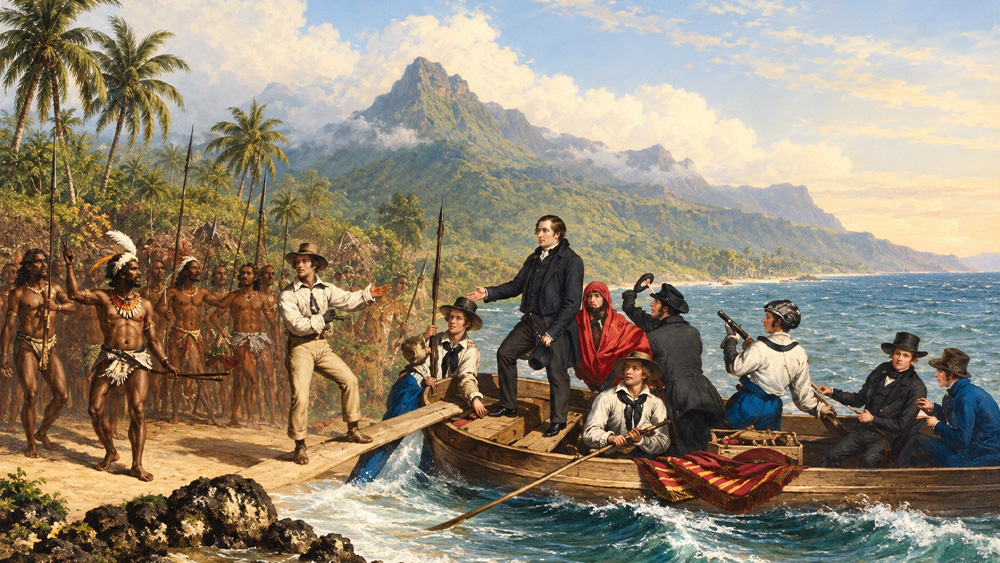
The first of the London missions was to Tahiti, in the South Pacific. Arriving in 1797 on the Duff, 30 missionaries would set out to achieve religious conversion, 17 of which would remain and settle in Tahiti (Council for World Mission, 2022). By the 1830s, mass conversion had been achieved by means of a top – down strategy (Gunson, 1978), in which London missionaries targeted chief Pomare II to convert first, knowing the Tahitians to be a loyal people, who would now convert to support their King. In Tahiti, conversion was mutually beneficial, the chief wanting to expand and secure his political power and acquire technological advantages offered by London missionaries (Murray, 2002). What followed from religious conversion was a new, less official mission, to make Tahiti an outpost of British culture. This was seen with how missionaries became political aides, formulating laws under the Pomare Code which introduced strict Protestant rules for the indigenous to adhere to, and social reformists introducing Western literacy, education and healthcare (Murray, 2002).
Aside from the justification of a contemporary worldview in their armoury, is the context of Tahitian society, which missionaries wrote of as preeminent examples of savagery and barbarity (Lovett, 1899, p.152). Considering practices of infanticide and human sacrifice, it was deduced that Christianity could only flourish in a European model of civilisation. Furthermore, London missionaries considered it duty to protect the vulnerable by establishing the only order they knew, in face of a perceivable show of cruelty. Once established, London Missionaries intervened across sectors of law, politics, agriculture, education, medicine and culture (Howe, 1984). The ethical validity of which will be assessed against whether it secured benefits the indigenous did not have before and once more, whether it contributed to the loss of customs and identity.
Furthermore, if the aim of London missionaries was conversion, it would not be to baptise the indigenous as Christian in name but anticipating they would align to biblical standards of morality and behaviour. Ultimately, the missionaries outlawed practices they deemed problematic, employing the death penalty in cases of murder and infanticide and establishing a judiciary who penalised ‘adultery, bigamy, theft and rebellion’ (Jehovah’s Witnesses, 2008). Foreseeably, this code would also enforce strict observance of the Sabbath, further Christianising society. With the cessation of violent rituals, Christianisation in Tahiti achieved secure social order and protection of the vulnerable, marking a period of Christian – brought peace or ‘Pax Christiana’ (Fer, 2011, p.1). “What followed from religious conversion was a new, less official mission, to make Tahiti an outpost of British culture.”
However, whether well intended intervention called on reshaping their whole way of life is to be questioned. The involvement of the missionaries ultimately stood for a display of cultural intolerance and absolutism, where the little regard they held for cultural preservation and the subsequent steps modern Tahitians have had to take towards reclamation, were preventable. Furthermore, the irony of missionaries breaking their own legal code demonstrates their unnecessary rigidity and fallibility.
Motivated by genuine belief in both salvation and the command to ‘go and make disciples of all nations’ (Bible Gateway, no date, Matthew 28:19-20), as well as the religious climate created by the Evangelical Revival, the missionaries set out to convert. Later, to also make Englishmen out of natives. Most convincingly, they saw themselves to be do-gooders, bringing the indigenous into the “modern” Western world. A perceived responsibility for contemporary colonial agents alike, the British Empire simultaneously accelerating in expansion (History Extra, 2021). Although, with hindsight, this was not their responsibility.
To a modern standard, cultural disruption is a hefty offence, especially with the memory of native treatment everywhere, seen in America or Australia (Amnesty International, no date) for reference. But once more, the reminder that the London Missionary Society was a part of that colonial world, who believed they conducted themselves with Christian values, and an ethical code at least relevant to the day. What can be learned from missionary operations in the South Pacific is an appreciation for the historic lens, where contextualising events is vital, for across different periods, different ethical values are brought into focus. But now, regarding the 21st century, where provided the impact on indigenous life and customs which islanders are still fighting to reclaim, London missions are an unconvincing show of truly, faultless ethical operations.