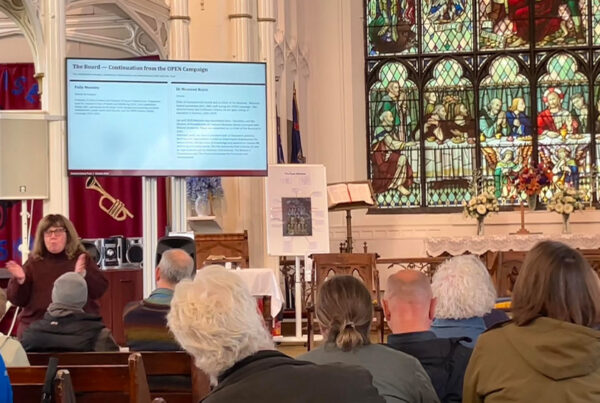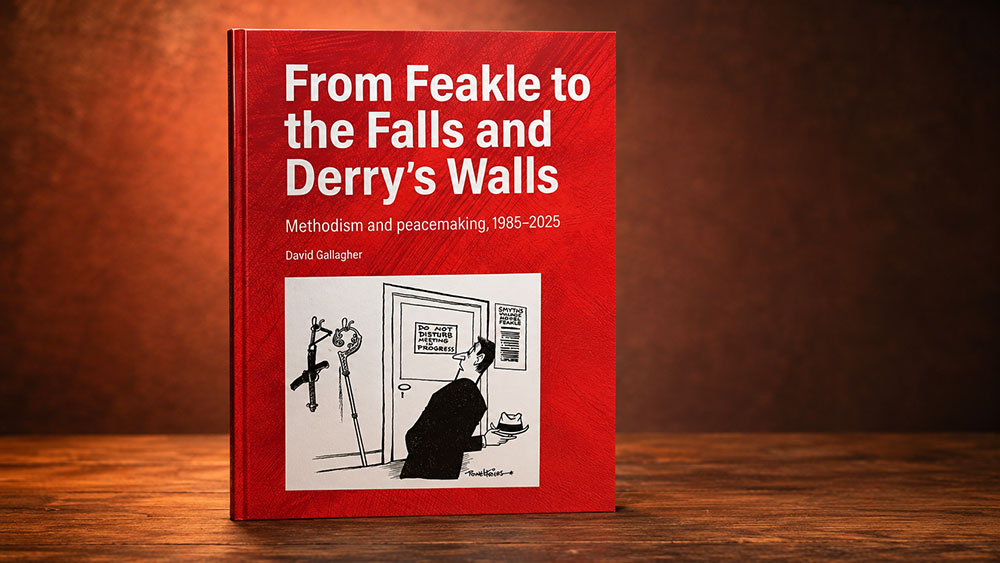
A fortnight after the book launch of my recently self-published book ‘From Feakle to the Falls and Derry’s Walls: Methodism and peacemaking 1985-2025’, I received this email by way of enquiry as well as validation.
“I’d be curious to know if you are the grandson of the Rev Robert H Gallagher who wrote “My Web of Time” – a copy of which I still have. When I knew him as a teenager – and he was the age then I am now – he was or seemed to me – to be one of the most remarkable men I had ever met or would ever meet with an undauntable faith in what he felt he was called to do and to be. Perhaps that is in part the source of what enabled you and your colleagues to engage well outside what must have been your comfort zone and engage with the realities of Northern Ireland.
XXXX presented me with a copy of your book which I have read from cover to cover. Other people have written books to justify themselves, their community, their continuation, their perspective. You and your colleagues have produced a book which – please God – will ensure that no-one else will ever feel the need to re-tread your footsteps and write for a future generation another book like yours because we should never again as a people be trapped in our misunderstandings.”
To set the reader’s mind at ease, and that of the person who emailed me, then I declare willingly that I am the grandson of Revd RH Gallagher and son, therefore, of the Revd Dr RDE Gallagher. However, I will address the issue of whether this grandson was faithful to his grandfather’s and also, in terms of immediate lineage, his father’s legacy later. But the second paragraph of the email suggests that there was a corporate responsibility as well as personal. Therefore, the issue of being faithful to the expectations and instructions to a corporate body such as the Methodist Church in Ireland needs also to be addressed.
At the early proof-reading stage, the BBC One reality programme, The Traitors, came to its dramatic conclusion. As Claudia Winkelman delivered the punch line of all punch lines: ‘Two Traitors, but totally faithful to each other”, I saw an obvious similarity between the programme and my project: How much of private conversations should be revealed and at what stage? In other words, should “what is said in the tower, stay in the tower”? That is a fundamental dilemma for a programme editor and researcher alike.
Research drew on my own extensive archive and the recollections garnered from fellow Methodist participants, and others. It catalogues and critically assesses the contribution of Methodism over four decades
Some of the research and subsequent commentary is a re-hash of that which was always in the public domain. Other information has been included to explain the context to Government documents and initiatives now available to public scrutiny. New evidence is provided for the first time. The disclosed archive provides balance, further insight and perspective of where the Methodists were coming from. In terms of transparency, so far, so good.
There is a potentially serious criticism of the ‘tell-all’. The criticism surrounds the possible, or actual, breaking of confidences, not just unfair on the unsuspecting and “innocent” individual(s) involved but through publication making it more difficult for such or similar initiatives from taking place in the future. It becomes a question of trust.
Thirty years have passed since the vast majority of these meetings took place; such a time lapse can allow for revelation safe in the knowledge that information will do more to illuminate than harm. It is time for the story of so many quiet peacemakers to be told.
The book offers such revelations as
- the first official meeting Gerry Adams had with any Church – two versions of the same NIO document are published, one redacted, the other unredacted; the difference between the two explained
- responding to a call for help from John Hume and Gerry Adams and then sending a message to Downing St in an attempt to prevent the breakdown of the ceasefire. Several “red box” memos are revealed including what John Major really thought of John Hume
- meeting Martin McGuinness a fortnight after the Canary Wharf bomb with the full script of what the Methodists said to him
- meeting the Mitchell Commission on Decommissioning and, in particular, Revd Harold Good’s reply to a question about the possible role of the churches in decommissioning, some ten years in advance of his involvement with Fr Alec Reid as ‘eye witnesses’
- a chance conversation had by the author with Alastair Campbell leading directly to a Prime Ministerial sound-bite; and the key concept was “trust”!
It is contended that the Methodists – known as the B Team – were listeners and interpreters. They were encouragers and challengers; to encourage does not mean to add or lend support or agreement per se rather it is to affirm the democratic path of dialogue. All were challenged not just with the straightforward “what do you mean?” but rather “what else can you do or give?” Indeed, to associate “with” does not mean acceptance “of” despite the criticism of treason and secret pacts being made. The Methodists were, on a few occasions, facilitators across the spectrum for loyalists, for republicans and for the state. Elsewhere, they were shuttle diplomats but only to the point of “I know you are meeting them so please tell them…” They did not act as back channels as such rather as conduits of impressions and understandings. It also is the case that at no point did these meetings change purpose; they were always about trying to understand the other, never about negotiation.
In all of this, the B Team followed the expressed expectations and instructions as determined by their immediate committee – the Council on Social Responsibility (Northern Executive) – to which they were drawn from and had to report to. Multiple Minutes confirm this contention. In turn, in terms of accountability and transparency, the Northern Executive reported annually to the main decision-making body, the Methodist Conference.
Was the author faithful to his lineage? Interestingly enough – and perhaps intriguingly – the title of the book suggests a metaphorical journey from Feakle, better known as the venue for the dialogue in December 1974, between eight Protestant clergy and the IRA Army Council. My father, Revd Dr Eric Gallagher, was one of the eight Protestant clerics. The author regularly refers to the passing of the ‘Feakle baton’ as well as acknowledging that the reputation of Methodism in peacemaking has been long-established. Indeed, at a pivotal and initially exceptionally tense meeting with Martin McGuinness in the immediate aftermath of the Canary Wharf bomb, when it was mentioned by one of my colleagues who my father was it seemed to have a significant transformational effect.
From Feakle to the Falls and Derry’s Walls: Methodism and peacemaking, 1985-2025
(price £20.00) is available from the Evangelical Bookshop, Belfast; Secret Bookshelf, Carrickfergus; An Creathu Poili, An Culturlann, Belfast or direct from the author (davidgallagher904@gmail.com)
Dr David Gallagher was Lay Secretary of the Methodist Church Council on Social Responsibility’s Northern Executive from 1990-2003 and Senior Vice Principal of Methodist College Belfast from 2007-2013.