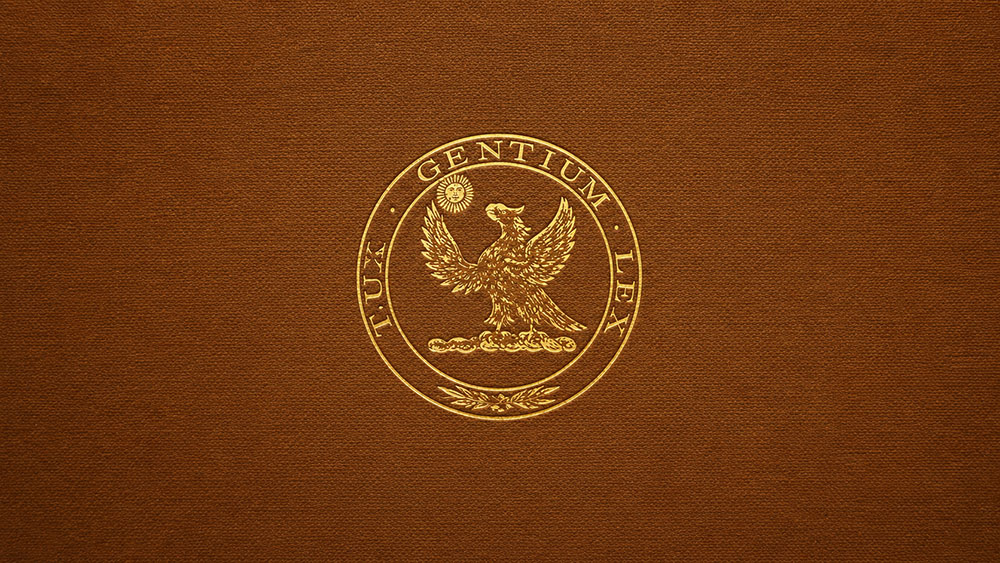
How did a schoolboy growing up in Northern Ireland in the 1970s become a lawyer in England? It was my love of, and respect for, books that set me on this path. My imagination was lit when a man called Liam Campbell, a solicitor, placed into my 16 year-old hands a copy of Snell’s Principles of Equity – a weighty hardback cloth-bound tome emblazoned on the front cover with esteemed law publisher Sweet & Maxwell’s trademark golden logo, an eagle surrounded by a circular border in which were written the words “Lux Gentium Lex”, Latin for “law is the light of the people”.
It was as much the weight, feel and smell of the book as its appearance that caught my attention – like all good legal textbooks of a certain age, its pages, when smelt closely, gave off that delightful scent of mustiness, so redolent to me now of good solid oak floor-to-ceiling library bookshelves proudly hosting complete runs of The All England Law Reports, the Weekly Law Reports, the English Reports and Halsbury’s Laws of England, a smell that can take me back in an instant to the subterranean law library of Trinity College Oxford, the rather grander Bodleian law library in Oxford’s St. Cross building and the wonderful libraries of Freshfields and Allen & Overy, oases all of calm and learning, but I am getting ahead of myself.
I had the privilege and luck to grow up in what the late Gerry Anderson called stroke city – Derry-stroke-Londonderry; the maiden city; lovely Londonderry on the banks of the Foyle. The 1970s might not have been the most auspicious time to be a teenager in Derry but for me, growing up there at that time was a care-free and happy experience, with the dark shadows cast by the “Troubles” lightened always by the wry, dry, dark and self-deprecating humour of Derry people. At the age of 16, I spent a summer working as an office boy in the once magnificent but by then genteelly shabby Georgian offices at 8 Shipquay Street of Dickson & McNulty, solicitors, courtesy of my father’s solicitor, W. Bristow Stevenson, who was one of the three partners in the firm, the others being “old Mr. Dickson” and a Mr. Long.
Bristow himself was a gentleman farmer-cum-solicitor, a tall, brisk, solidly-built and kindly man with shining dark eyes, always impeccably dressed in a grey three piece birds-eye suit with a silk handkerchief in his breast pocket and wearing highly polished much-mended black brogues. Old Mr. Dickson was ancient and very frail. He would come into the office from his house in Fahan, County Donegal, once or twice a week and was rarely seen outside his dark and mysterious rooms on the top floor of Number 8 which commanded a magnificent view of St. Columb’s cathedral. His daughter, Caroline, the diocesan architect, was overseeing the replacement of the sandstone orb-shaped finial on the top of the spire, a procedure we watched with interest from the office. (Now I am writing in ‘ORB’, I might mention that John Newton, the Olney curate who composed Amazing Grace, prayed twice daily in this St Columb’s Cathedral after he had come ashore during the storm which prompted both his conversion and Amazing Grace.) The only real bit of legal work I did that summer was researching a point on the rule against perpetuities for Mr. Dickson. He judged my resultant memorandum “interesting”.
I didn’t learn much law in my summer at Dickson & McNulty but when I was not running errands to the Petty Sessions office (where I would be regaled with tall tales by the garrulous clerk, Hugh Fergusson), listening to unruly citizens being upbraided by resident magistrate Paddy Maxwell in Derry’s magnificent Georgian courthouse, or taking affidavits to be sworn at the offices of Fraser Mitchell, the commissioners for oaths round the corner on Castle Street, I filled my time discovering the joy of serendipitously dipping at random into a volume of the All England Reports (or even better, the pre-1922 Irish Reports) and seeing where one might land. It was Bristow whose face lit up when he saw me reading a case report, pressing me to remember that behind the dry reporting were real people – solicitors, barristers, judges, court reporters, stenographers, plaintiffs and defendants, who had argued the case, sat through days in court, laboured over their pleadings and carefully written their judgments, and who suffered the terrors of cross-examination and the highs and lows of victory and defeat.
It was Bristow, also, who reminded me that the last Lord Chancellor of Ireland, Sir John Ross, was an old boy of my school. Bristow lent me a copy of Maurice Healy’s famous memoir, “The Old Munster Circuit”, which contained an affectionate, respectful and humorous pen-portrait of Sir John. On my last day in the office, Bristow suggested that I should follow Sir John into a career in the law. That was all it took, really, and 47 years later, I have no regrets, although it must be said that my labours as a journeyman solicitor in the legal vineyard have been much less distinguished than those of Sir John. I was encouraged by teachers at school to apply to Oxford or Cambridge to study law. Knowing almost nothing about either university, I applied to, and was accepted by, Trinity College Oxford which was where Bristow himself had studied as an undergraduate and was the only Oxbridge college I knew anything about. By way of an aside, when I took office as co-President of the Foyle College Former Pupils Association (FCFPA) in 2024 I was tickled to notice that the very first wearer of the magnificent and weighty presidential chain of office was none other than Sir John Ross himself.
Stephen Gillespie, a solicitor since 1987, is general counsel of LetterOne