It was a close day as we’d call in it Ireland. Neither hot nor cold. The air filled with moisture and a gentle rain. Like shards of silk falling from the low clouds that framed the fields around.
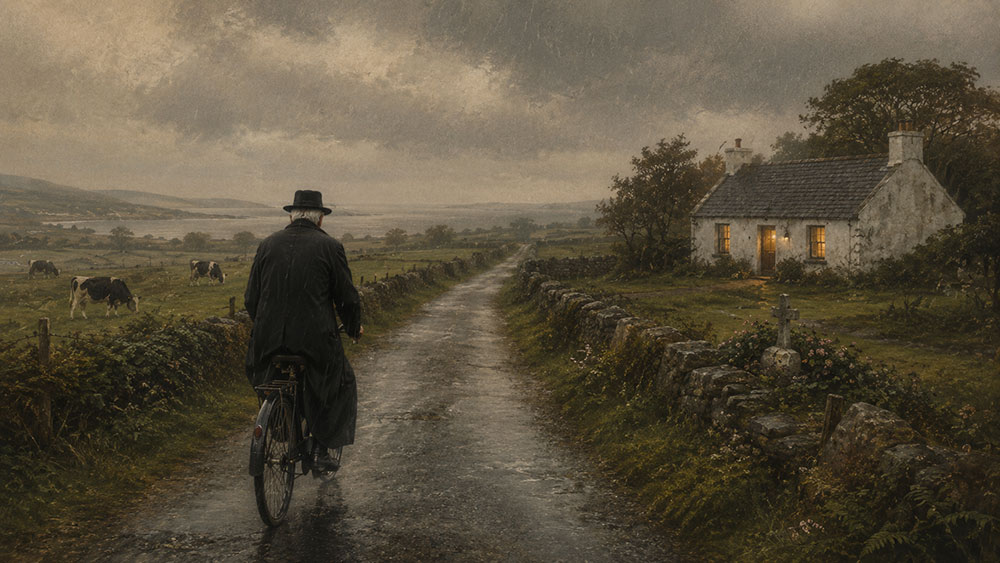
I stand on the road. A long straight road that stretches out into the distance. Straight as far as you could see. Flanked on either side by hedgerows and beyond them fields of cows grazing. The only noise to break the silence. In the distance appears a solitary figure on a bicycle. Dressed in black, barely moving fast enough to stop from falling over. I watch the tiny figure turn into the shape of a man. A priest. Clad all in black. A black hat on his head. The wheels of the old black bicycle turning barely quicker than his legs.
In the distance, as the wheels turn, slowly, the figure in black struggles upright – a glimpse afar, becoming whole; pedals barely rotating. Around us only the bovine music of cows, the fields – the rest, locked in silence by hedgerow and road. The air still with nature’s breath while the sky above is a leaden grey, clouds bulging with rain.
The figure in black becomes man; white hair beneath the black rimmed hat, ruddy face, unblemished by life, shoulders heavy with the weight of sin. His fingers enclose the steel handle bars as he leans the bicycle gently against the gate. A smile breaks, eyes – shine a blue the sky should be, bright as new buttons on a weathered coat.
Hands embrace, warm and calloused, a friendship glove – our feet scrunch on grey gravel, noses filled with the smell of turf; sweet. The priest’s eyes twinkle, innocent mischief. Our footsteps towards the pantry door break the muffled silence. The old man walks bent with grace, a bicycle clip on his ankle still – around us the silver, silken shards, continue to fall gently on our shoulders.
The warmth of the kitchen fills our faces as we open the back door of the white washed cottage with the grey slate roof and step inside.
“The figure in black becomes man; white hair beneath the black rimmed hat, ruddy face, unblemished by life.”
An Irish lunch is laid out on the wooden table; bread, ham, tea – lots of tea – a glass of whiskey, “Ah go on now Father,” and conversation ricochets about family and friends.
The sound of Grandma Brid’s slippers softly shuffle to-and-fro from oven to table. A carousel of toast, bacon, sausages, “ Don’t be giving any more to the dog’”.
“Ah it’s just a little bit,” as the silver dog greedily licks the last of the fat from generous fingers.
The table fills as the plates empty. Papa is sat in his usual chair.
“More tea Father?” Says Grandma, “Ah you will just have a little drop?”.
“A glass of whiskey Father?” she offers, “It’ll warm you up so it will. Just a small one, so. Lixie fetch Father the crystal glass from the press in the parlour.”.
And after a while, with stories told and tea and whiskey drank, the priest and I look at each other and we stand up in unison, and head back out into the gentle rain. I had dug a small hole amidst the flowers. A small pile of stones next to it. Mother beside it and our daughter between us. My parents come out quietly in their slippers. Standing by the door. The gentle rain forming a silver shroud to their hair.
And the priest begins to pray and blesses the ground with water to make it Holy and I place the small white china jar that I hold in my hand into the hole that I had dug and more holy water falls on top. Inside are the ashes of Éireann. Our unborn baby. Fetched by me from the crematorium where unborn babies are sent to take her home to Ireland, to her family and the mud of her ancestors. From one womb to another.
“Amazing Grace, played by a lonely pipe in the soft falling rain.”
I recite the Song of the Wandering Aengus, “She had become a glimmering girl, with apple blossom for her hair”, and our tears mingle on our faces with the gentle rain.
And then the priest pulls a pipe from his pocket and plays, “Amazing Grace… how great thou art.” And we listen and cry gently to ourselves as I fill the hole with my hands, the wet mud beneath my fingernails, and I lay the stones carefully on top.
The only noise is the silence and the sound of the lonely pipe.
And I think amongst the million thoughts of our little girl, who is one of us and always will be but will never feel the gentle rain nor hear the silence, and how many could claim such a requiem as this….
I thank the priest. I thank him for our blessing. “Well it wouldn’t be the Church’s way …” he says, stumbling, “but I …..” And he stops. And I’m grateful.
And now, as the seasons roll on, the cottage is sold. Our only piece of ground with its Irish sky above, loaned on to another. The priest too is gone now, laid under his own blessed earth, “In God I have all the help and grace I need”, he would say.
“Grace. A name. A virtue. A word that can change the world.”
I drive the straight road back with Gracie. Gracie, our youngest now, who would not be here were Éireann not in the ground. Grace. A name. A virtue. A word that can change the world. Isn’t that what Bono sang? Amazing Grace, played by a lonely pipe in the soft falling rain.
And I return to the cottage, for the last time. Beneath the same leaden sky. I claw the mud again with my fingers at the little spot we had made beneath the ivy and retrieve the glass jar and the little white urn inside. I pack some of the blessed earth inside the jar and hand it to Gracie. A sister in her sister’s hands.
The long road stretches back out again ahead. And the footsteps and memories of our ancestors tread like ghosts forming between the hedgerows around us.
The cycles of life, from the heavy, leaden clouds to the silver shards of rain – and back again.